
Throughput Over Posture:
Where Ideas Become Systems

Overview
A map tells a story with lines that trade ships and data packets never see. It is still the right place to start. When the most common partner on the world’s export and import invoices shifts, institutions shift with it. Curricula adjust. Standards bodies tilt. Logistics firms rewrite their playbooks. Research agendas find new collaborators. The trade map is not a press release. It is a wiring diagram.
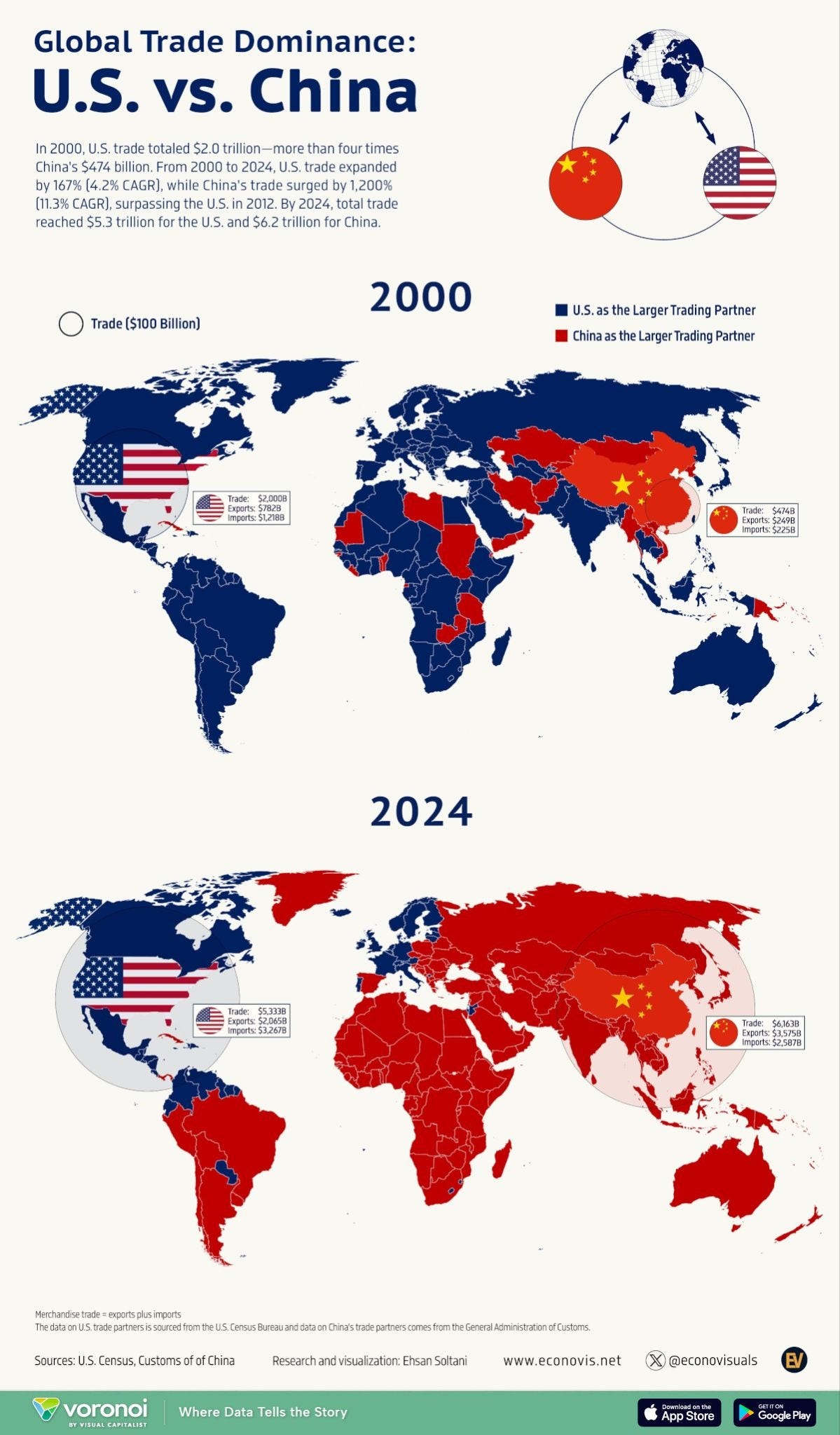
From that diagram, a practical rule follows. Talent flows toward ecosystems where good ideas can be turned into working systems quickly, with friction low enough to be tolerable for real people with finite time. That rule has no respect for political slogans, but it is sensitive to supply chains, regulatory predictability, grant cycles, and language. It rewards places that can iterate hardware, deploy at scale, and finance expansion without drama. It does not award points for nostalgia.
This essay expands six linked claims and turns them into a field guide for the next decade in engineering and applied knowledge. The frame is not ideological. It is operational.
1) Trade Gravity Is Institutional Gravity
When a single node becomes the dominant trading partner for most of the world, that is a structural signal. It means commercial habits, invoicing currency preferences, logistics routes, and procurement playbooks are re-anchoring. Over a span of years, vocational education, technical accreditation, and cross-border research programs tend to follow that gravity. Companies chase their suppliers. Universities chase their companies. Students chase both.
The mistake analysts often make is to treat trade as a narrow economic domain, cleanly separated from knowledge production. In reality, procurement departments and lab managers often occupy the same hallway. When a firm reshapes its supplier roster, it simultaneously reshapes the collaboration network through which staff learn new components, tools, and standards. Memoranda of understanding between universities rarely lead collaboration. Purchase orders do.
The second mistake is to treat the new hub as a monolith. Trade dominance does not mean a single command centre. It means thick corridors where freight, finance, standards committees, and technical service companies build muscle memory together. Those corridors become the best classrooms for applied work because they generate mistakes at scale and fix them in public. They produce the technician as hero, the process engineer as dramaturge, and the quality specialist as final editor.
A final point on gravity. Trade-based centrality also pulls in the quieter systems that sit behind build speed: certification bodies, testing labs, component catalogues, metrology services, and the legal infrastructure that makes contracts predictable. Engineers who move through such an environment learn more than how to solder and scale. They learn how to coordinate timelines, budget uncertainty, and manage complex vendor relationships. Those lessons do not expire.
2) Renewables and Electrification Are Throughput Frontiers
The energy transition is not a marketing campaign. It is a set of industrial chores that include solar modules, inverters, power electronics, battery cells, battery management systems, electric drivetrains, grid software, and the civil works required to connect it all. It is a story of components, reliability curves, service networks, and financing. That reality privileges places that can produce high volumes of good-enough parts and integrate them into working systems across cities, towns, and mines.
There is romance in breakthrough chemistry. There is career safety in competent integration. The transition will reward both, but the employment base and practical learning will sit closer to integration and deployment. That is why the manufacturing corridors that ship photovoltaic modules, inverters, and battery packs in vast numbers are also becoming de facto training grounds. When a grid needs 10,000 more inverters this quarter, you learn at what temperature a connector fails, which firmware update bricked a line of units, and which supplier’s quality drifted after a holiday. A real transition is full of such ugly and instructive details.
Fossil energy is not disappearing in one electoral cycle. It is being demoted from default to optional, then to speciality, as storage scales and grids digitise. Many jurisdictions will carry a mixed stack for decades. The action that matters for applied engineers is at the margin where a coal unit is retired early, where a renewable project bids into a capacity market, where a mining fleet electrifies a pilot line and then scales. That margin is where throughput competence is built, not through slogans but through commissioning schedules and warranty claims.
When a country’s companies dominate the supply stack for solar, batteries, and power electronics, they gain speed. Speed compounds into learning. Learning compounds into cost discipline and then into market share. The loop is practical, not ideological. The labs that tie into this loop, wherever they are located, find their graduate students working with real parts on real schedules, and their sponsors are happy to renew grants because the prototypes left the bench and entered a warehouse.
3) Frontier Science Is Multipolar, Deployment Is Even More So
A sober reading of research outputs today shows a world without a single monarch. The lab that proves a new theoretical result in one place may share authors with the lab that prints the wafer in another. A high-impact paper may still emerge from a small number of elite campuses, but the pilot plant often stands far from those campuses. The winners now coordinate across borders, with clusters of excellence in applied physics, power electronics, software tooling, advanced manufacturing, and materials science distributed across continents.
There is dignity and difficulty in being a deployment superpower. That status goes to places that can permit, finance, build, and commission at scale. It is a different skill set from producing elegant theory. Both matter. The best teams mesh them, with researchers who are comfortable moving between simulations and procurement lists. That is why journals tell one story and customs records tell another. If you only read the journals, you miss the gearbox problems that swallowed a quarter’s profits. If you only read the customs records, you miss the theoretical trick that made a new topology viable.
The healthy posture for an engineer is to honour both. Respect the global distribution of high-impact ideas, but ask an operative question before relocating your life. Where will I ship the third version of this device, for paying customers, within two years. If that answer is clear in one ecosystem and murky in another, the decision is not spiritual. It is logistical.
4) Policy Risk Is Real, Capacity Is Sticky
Politics matters because visas, grant windows, export controls, and institutional partnerships matter. Changes in those domains add noise to long personal bets. Yet capability, once built, is sticky. The laboratories, machine shops, supplier bases, and tacit knowledge embedded in a region do not vanish when a press conference ends.
Periods of tighter visa posture, sudden grant volatility, and rhetoric that spooks boards all raise the cost of committing a decade to a particular country. Engineers and graduate students are not brand tourists. They calculate odds. They look for places where a plan can survive a change in leadership. They ask simple questions. Can I bring my spouse? Can we renew our status without drama? Will our lab’s funding bridge the next budget fight? The answers do not need to be perfect; they need to be credible.
Where policy induces friction, flows adjust at the margin. They do not always reverse. Flag-planting narratives collapse under the weight of the data, which shows continued excellence in theory-heavy fields in some countries, and continued excellence in manufacturing and deployment in others. The wise planner resists the binary and watches the gradients.
5) Language Is a Gradient, Not a Wall
For years, global talent treated language as a hard barrier in some markets. That barrier has softened as universities, labs, and companies adapted to the realities of international collaboration. English remains the floor at which global knowledge trades, but it is no longer the ceiling in a number of corridors.
There is still a premium on bilingual competence. It is a quiet premium, not often advertised, but it shows up in who gets the more complex assignments and who is invited to the after-meeting where real decisions are clarified. It is the difference between reading a standard in translation and understanding the debate that produced it. English gets you into the building. The local language gets you into the control room. The highest leverage opportunities often sit behind that second door.
The practical takeaway is simple. If you can operate comfortably in English and in the language of the manufacturing or deployment corridor you care about, your friction falls and your throughput rises. That is not romance. It is logistics.
6) Choice Is Conditional: Match the Ecosystem to the Work
A practical, non-ideological guide for the next decade looks like this.
If you need to build speed, proximity to manufacturing, and high-volume iteration in renewables, storage, electrified transport, and power electronics, the major tech-industrial corridors of China offer top-tier environments. Not because someone says so, but because the parts, the factories, the integrators, the testing labs, and the permitting pathways are nearby.
If you need industrial engineering depth paired with regulatory stability and strong vocational traditions, Germany and its neighbouring engineering belt remain superb. Precision suppliers, standards culture, and reliability as a civic virtue make for a serious classroom.
If you need systems coordination, regional finance, cross-border deployment connective tissue, and geopolitical neutrality in Asia, Singapore functions as a strategic hub. It packs legal predictability, logistics fluency, and financial services into a compact space built for deals.
If you need deep theory, elite lab science, and venture ecosystems that can finance long bets, the United States remains on the table. It carries policy volatility and mood swings, but its capacity for breakthrough science and company formation is still significant. Eyes open, plans flexible.
None of these choices requires marriage to a flag. They require a clear map of the work you intend to do and an honest audit of your personal risk tolerance.
7) The Throughput Model
Think of the world as a set of pipes and valves, not a podium. Ideas convert into systems where the pipes are wide, the valves are open, and the operators know how to avoid cavitation. Throughput is the rate at which working product flows for real customers. The inputs are obvious: talent, parts, capital, standards, test rigs, and the social capital that makes cooperation normal. The outputs are deployments measured in gigawatts, fleet conversions, factory lines installed, and maintenance contracts signed.
In such a model, prestige helps but does not decide. You can add brilliance at the input, but a clogged valve or a missing gasket kills the run. You can pour money into a lab, but if a pilot cannot be permitted, your idea dies in a PDF. You can announce a partnership, but if the second-tier supplier misses tolerances and no one can fix it locally, your schedule becomes theatre.
Throughput respects competence. It rewards places that cultivate more competent people, the kind who show up to the plant at 6 a.m., tighten the right bolt to the right torque, and send a data log to the right inbox. It rewards boring excellence. It rewards the legal clerks who process a work permit without losing a document, the accountant who fixes a tax code classification that was misfiled, and the mid-level manager who refuses to lie about timelines. In mature corridors, these invisible people add up to visible speed.
The political corollary is not a slogan. It is a plea for institutions that reduce uncertainty. Where those institutions are healthy, throughput is healthy. Where they are not, projects limp.
8) Case Studies in Practical Choice
A power electronics startup choosing a base
A team with a new inverter topology faces two choices. In one ecosystem, the universities offer renowned advisors, a network of investors eager to fund the leap from prototype to product, and a media sphere that celebrates the effort. But the suppliers are far, certification queues are long, and pilot customers do not yet have procurement authority to do large, fast orders. In the other ecosystem, the advisors are less famous, the venture market less theatrical, but the suppliers are nearby, a testing lab is available this quarter, and a regional utility is running weekly tenders.
If the company’s advantage depends on learning by shipping at volume, the second ecosystem wins. Not forever. For the next two product cycles. The team can revisit the location as the topology matures and brand credibility grows. This is not ideology. It is sequencing.
A battery materials researcher choosing a PhD track
A researcher with a strong interest in solid-state interfaces evaluates programs. One option offers deep theory, world-class microscopy facilities, and a publishing culture that reliably lands papers in elite journals. Another option is attached to a pilot line where new electrolyte formulations are run through a small but real cell manufacturing process, with industrial partners sending engineers to the lab each week.
If the researcher’s goal is to remain in academia, the first option is strong. If the goal is to lead an applied group that scales processes into factories, the second option provides exposure to line realities that journals do not capture. The right choice depends on the life the researcher wants, not the rhetoric of any country.
A grid systems engineer planning a 10-year run
A grid engineer focused on distribution-level storage and smart inverters maps the next decade. There are three plausible homes. A regional hub that coordinates ASEAN-wide deployments and finance. A European seat that offers stable regulation and deep standards work. An East Asian corridor that is installing large volumes of battery-backed solar at a pace unmatched elsewhere.
If the engineer wants to become a translator between regulation and technology across borders, the hub wins. If the engineer wants to write the standards that utilities will adopt in 2032, the European option shines. If the engineer wants to lead teams that commission 200 megawatts every quarter, the East Asian corridor is the right classroom. All three are honourable. Only one will maximise a given person’s learning curve.
9) The Role of Universities and Vocational Systems
Universities set the tone for a country’s knowledge posture, but they do not own training. Vocational schools, apprenticeship systems, and in-firm training programs teach the muscle memory that turns designs into machines. Regions that respect this layered model, pairing theoretical excellence with disciplined vocational pathways, outperform.
The world’s next decade needs more mechatronics technicians, commissioning engineers, high-voltage electricians, power systems analysts, and reliability engineers. It also needs researchers who can converse with them, write papers that matter to them, and accept that a method section which includes a maintenance plan is not somehow less scientific. Respect flows both ways. In high-throughput corridors, you see this respect in the lunchrooms, not only in the newsletters.
Universities that want to remain relevant will coordinate more intentionally with manufacturing clusters and deployment agencies. They will rotate students through industrial placements, write theses tied to real commissioning schedules, and reward faculty who can move prototypes into pilots without burning out their students. The reward will not only be citations. It will be alumni who find meaningful work quickly and industrial partners who renew sponsorships without needing to be schmoozed.
10) Finance as the Quiet Accelerator
Money is a signal, but not all money is the same. The kind of capital that matters for engineering is patient enough to see a plant through commissioning, familiar enough with industrial risk to avoid panic, and local enough to solve problems with a phone call. Ecosystems that offer this mix accelerate. Ecosystems that only offer grant seasons and headlines stall.
Project finance for renewable assets, working capital for component suppliers, bridge loans for certification delays, and insurance products that understand new technologies are all part of the same bloodstream. An engineer who ignores finance does so at personal cost. The next decade’s builders will learn not only how to produce a bill of materials but how to sit through a credit committee meeting and explain failure modes in language that a banker respects.
Financial centres that position themselves as honest brokers for cross-border industrial projects will gain influence without swagger. They will sharpen due diligence in clean energy, upgrade legal services for complex offtake contracts, and train analysts who can read both a term sheet and a test report. The best of them will achieve something rare in our era. They will reduce drama.
11) Standards and Certification: The Boring Levers of Power
Standards convert parochial wins into global habits. Certification converts lab claims into market access. These domains look boring until you miss a cycle and spend a year reworking a product to meet a clause you ignored. Ecosystems that invest in standards participation and certification capacity create an asymmetry in favour of their firms. Their engineers learn the debates early. Their products arrive ready. Their competitors’ products arrive with apologetic emails.
Over the next decade, power electronics, grid integration, safety protocols for large-format batteries, and testing for high-utilisation components will see accelerated standardisation. The engineers who learn to love committee work, or at least to respect it, will fail less often. Firms that sponsor such work, even when the marketing team cannot see the immediate payoff, will pull ahead.
For students, a single semester interning at a certification lab can be as instructive as a year in a classroom. For mid-career professionals, a stretch assignment to a standards body can translate into better design instincts and lower project risk. These investments do not make headlines. They make revenue.
12) Geopolitics Without Drama
It is easy to write geopolitics with a novelist’s appetite for conflict. It is harder to plan a life with that tone in your head. Engineers, students, researchers, and operations leaders need a cooler register. They need a map of risk, not a drumbeat. The practical truth is that states will continue to disagree, sometimes sharply, about security matters. They will also continue to trade, collaborate on standards, and co-author papers because reality demands it. The next decade will offer both tension and handshake.
Policy changes can raise the cost of certain collaborations, delay some shipments, and complicate visas. They can also provoke useful investments in resilience, encourage new corridors, and professionalise risk management inside firms that grew too casual in the last era. It is wise to maintain optionality, cultivate relationships in more than one corridor, and avoid tying career plans to a single favourable assumption. Optionality is not cynicism. It is prudence.
For those considering time in the United States during a period of policy volatility associated in the public mind with figures like Donald Trump, the advice is measured. Ask for specific assurances from host institutions. Understand grant timelines. Keep a backup path. For those considering long runs in East Asian manufacturing corridors, ask operational questions about intellectual property practice, contract enforcement, and language support. For those considering the European engineering belt and the broader continent, ask about long-term energy policy stability and training pipelines. For those considering hubs like Singapore, understand the rental market and the cost of labour when building teams. These are practicalities, not ideology.
13) Language and Cultural Competence as Force Multipliers
Bilingual engineers do not simply translate words. They translate risk. They notice when a supplier is being polite rather than honest. They understand when a yes is a try and when a yes is a promise. They read a meeting room quickly. In high-throughput corridors, such skills keep projects alive. They are rewarded quietly with responsibility.
Universities and employers who claim to care about global competence should audit their actual support for language learning. It is one thing to print a brochure with flags. It is another to fund serious language instruction for technical staff and to hire local mentors who take cultural coaching seriously. The teams that do this will experience fewer misunderstandings and will ship more often.
For individuals, a practical plan is best. Pick a corridor. Learn the language to a level where you can read a standard, argue respectfully, and joke at lunch without panic. Seek mentors who have done the same. It is not glamorous. It is decisive.
14) The Human Pace of a Fast Decade
Time matters. A decade is a human unit. It is a span long enough to build a plant, raise a child past primary school, complete a PhD and a postdoc, or see a product through three revisions. You cannot run it on headlines. You need a steady plan that protects your energy and your relationships while you do meaningful work.
Institutions should respect this human pace. Offer clear visa pathways. Publish grant cycles on time. Avoid using students as pawns in policy battles. Invest in mental health without using therapeutic jargon to avoid structural obligations. Treat technicians with respect. Pay invoices on time. Structure apprenticeships that lead to real jobs. Reduce performative bureaucracy. These small civic choices compound into throughput as surely as new machines do.
Individuals should protect their pace as well. Choose work that teaches, not just work that flatters. Choose managers who can deliver, not only managers who can talk. Stay close to the factory floor, the test rig, the site, the commissioning checklist. Visit the customer. Listen to the person who signs the maintenance contract. Learn the difference between a delay caused by a supplier and a delay caused by your own poor specifications. Write more after-action reports. They will save you later.
15) Risks to Watch
No model is permanent. Here are the most credible risks to the throughput view.
First, concentrated supply chains can choke. Natural disasters, policy shocks, or local financial stress can expose overreliance on a single corridor. The mitigation is not to abandon efficiency, but to build selective redundancy and maintain a bench of secondary suppliers.
Second, standards can diverge. If competing regions lock in incompatible standards for core components, integration costs will rise and learning will fragment. Engineers should watch these committees as closely as they watch funding rounds.
Third, financial markets can sour on industrial risk at the exact moment when deployments need patience. Firms should cultivate relationships with financiers who understand asset-heavy transitions and will not flee at the first delay.
Fourth, societal patience can thin. Communities that feel disrespected by deployment processes can stiffen against new projects. The solution is respectful engagement, compensation structures that feel fair, and long-term jobs that are visible and dignified.
Fifth, language progress can stall. If organisations claim bilingual support but do not live it, the talent pool narrows and error rates rise. Leaders should audit their own corridors and fix gaps.
16) What Students and Early Career Engineers Can Do Now
Write a clear statement of purpose for the next five years of your life. Do not include slogans. Include skills you want, systems you want to touch, and communities you want to serve. Map the corridors that teach those skills. Look at airports, supplier maps, certification labs, and employers with good reputations among technicians.
Apply to programs that rotate you through real factories or grid projects. Negotiate for placements. Accept that your first job should be heavy on learning and light on vanity. Learn the basic financial skills that make you eligible to be a project managers and bankers. Learn the local language if your course requires it. If you cannot learn it quickly, pair with a teammate who can, and reward them properly.
Refuse outrage as a hobby. You will need that energy for design reviews, commissioning weeks, and rebuilds. Find mentors who enjoy fixing things more than they enjoy talking about fixing things.
17) Guidance for Universities, Labs, and Companies
Universities should deepen co-ops and apprenticeships. Pay students for real work. Tie thesis topics to commissioning schedules and post-deployment analysis. Reward faculty who maintain genuine industry ties without letting consulting swallow their time. Provide serious language instruction tied to technical contexts. Build shared labs with certification bodies. Stop equating excellence with distance from industry; in applied domains, that reflex is outdated.
Labs should declare operational goals along with research goals. If you promise a prototype, define the test conditions under which it will be judged and name the partner who will try to use it. Publish fewer press releases. Publish more postmortems.
Companies should offer career ladders that honour technicians and field engineers. Pay for certifications. Protect weekends during commissioning when you can, and compensate properly when you cannot. Train managers to handle conflict without drama. Build redundancy in supplier networks and treat secondary suppliers as real partners, not as back-pocket afterthoughts. Share lessons with educational partners. It is not charity. It is talent development.
18) A Note on Culture and Dignity
The throughput model is not a worship of speed for its own sake. It is a respect for the dignity of work that actually lands in the world and serves people. A deployed megawatt, a bus fleet conversion, a hospital backup system that does not fail at 2 a.m., a factory line that gives a town good jobs, a water pump that works through the dry season. These are the fruits of competence married to respect.
Cultures that honour ordinary skill will do better in the next decade than cultures that honour only celebrity or virtuoso theory. That does not mean abandoning thought. It means situating thought in the company of builders and maintainers. It means dignifying the person with grease on their shirt and the person who writes the memo that saves a project.
19) Regional Notes Without Romance
It is useful to state the obvious, briefly and without sentimental language.
The East Asian manufacturing corridors remain the most impressive demonstration of scale in modern industrial history. They are not flawless. They are disciplined. They teach well by doing.
The European engineering belt excels in reliability, vocational standards, and serious social bargains around work. It is slower to permit, but careful in the best sense. If your temperament runs toward precision and long horizons, you will feel at home.
The hub cities that act as translators between regions will grow in importance. They will not house the most factories or the most famous labs, but they will gather the most contracts and the most cross-border teams. Their value is coordination.
North America’s research universities and venture ecosystems will continue to produce extraordinary labs and companies. Policy drama will remain a tax. Many individuals will pay it because the upside remains large. Many will hedge.
These notes sit beneath the broader truth. The world is a cluster graph, not a crown. It is a web, not a pyramid.
20) What Success Looks Like in 2036
Picture a career that starts in a vocational-heavy master’s program tied to a battery plant. The graduate spends two years on the line, learns failure modes, and then moves into a power electronics firm that deploys storage for a mining operation. They handle commissioning, learn to speak with grid operators, and train technicians. After four years, they pursue a mid-career fellowship at a European standards body, contribute to a key integration clause, and return to lead a cross-border project financed out of a regional hub. By year ten, they have shipped multiple systems, trained a dozen younger engineers, and authored a sober paper on reliability that other practitioners actually read.
This is not a celebrity arc. It is a builder’s arc. It pays in competence, community respect, and financial stability. It improves real places. It leaves systems better than it found them. The world needs many thousands of such arcs. The corridors described above are where they are most likely to happen.
21) A Practical Checklist
Define your work in verbs. Build, integrate, certify, commission, finance, maintain, standardise, teach.
Map the corridors where those verbs are normal. Include suppliers, labs, and hubs.
Audit your friction. Visas, language, cost of living, family needs, and grant cycles.
Choose a corridor for the next two product cycles, not for life. Reassess later.
Learn the local language to a level of operational respect.
Pair your technical plan with a financial literacy plan.
Volunteer for standards work. It will discipline your designs.
Keep optionality alive through relationships in at least one other corridor.
Write postmortems. They build institutional memory and trust.
Protect your human pace. This is a long decade, not a weekend.
22) Closing Argument: Study the Gradients, Reduce the Friction
What we have built is not a “winner takes all” narrative. It is a throughput model anchored in reality. Trade rewires institutions. Renewables and electrification are the growth frontiers with the broadest base of practical work. Frontier science is multipolar. Policy can raise or lower friction, but capability is sticky. Language is a gradient that rewards the bilingual with quiet leverage. Individual choices, therefore, should be conditional, not ideological.
The clever engineer does not marry a flag. They marry a problem set and a learning curve. They seek corridors where ideas move into systems with a minimum of ceremony. They respect the mechanic, the line leader, the standards committee, and the banker. They keep their options open and their schedules honest. They remember that time is finite and that the dignity of work lies not in the pitch deck but in the system that runs on a rainy Tuesday.
History will remain messy. Power will continue to shift in lumpy ways. Those who treat each lump as a crisis will tire and grow bitter. Those who treat each lump as a parameter will adjust their plans and keep building. If there is an ethic embedded in this operational view, it is humility toward reality and respect for the people who make reality work.
Perhaps we do not need louder claims about who leads. We need clearer eyes about where work gets done and kinder systems for the people who do it. The map is a cluster graph. The test is throughput. The reward is a world where more systems actually serve, and where more engineers finish their decade able to point at something that works and say, quietly and with pride, we built that.